Vector Problems
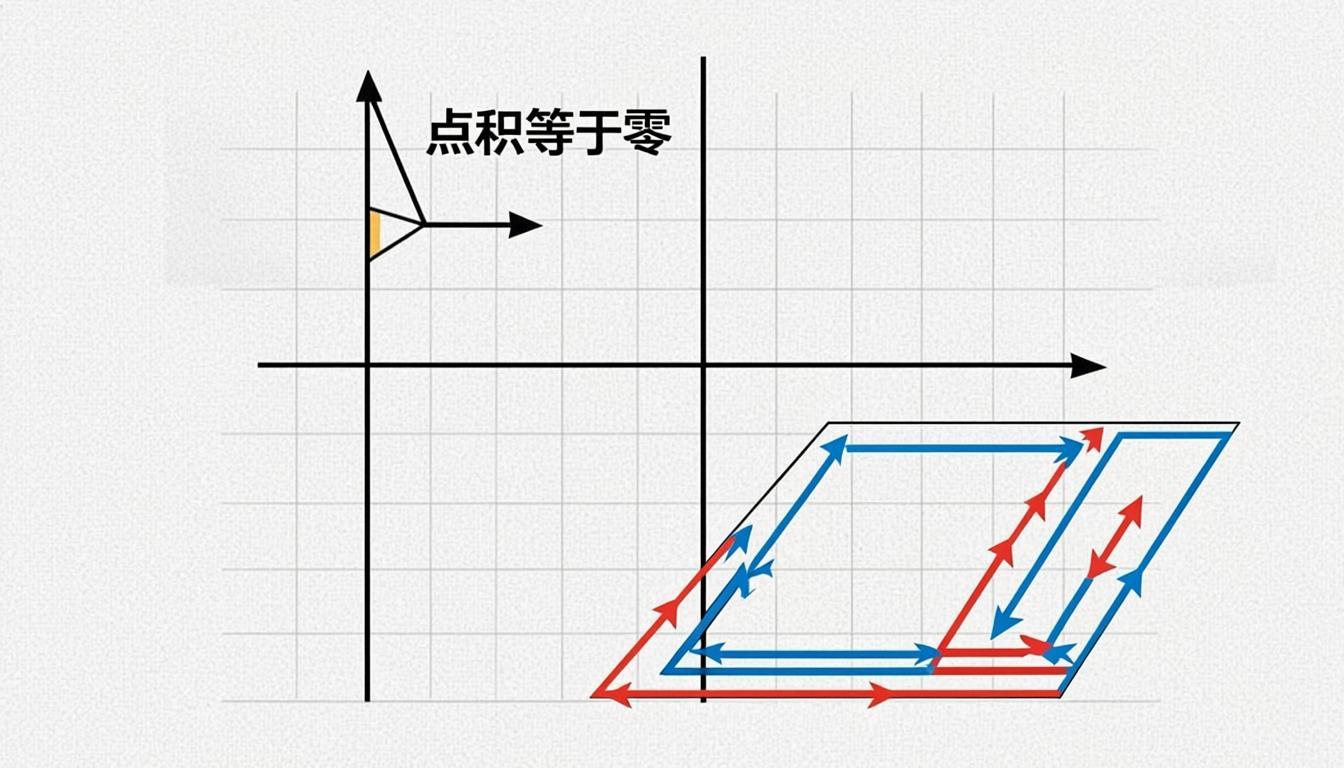
Proving a Right Angle
To prove that angle ABC is a right angle, compute the dot product →BA · →BC and show it equals zero. If the dot product is zero, the vectors from B to A and from B to C are perpendicular.
Example: Given A(1, 2), B(3, 4), C(7, 2). Is angle ABC a right angle?
→BA = (1−3, 2−4) = (−2, −2); →BC = (7−3, 2−4) = (4, −2).
Dot product: (−2)(4) + (−2)(−2) = −8 + 4 = −4 ≠ 0. Angle ABC is not a right angle.
Example 2: Given A(0, 0), B(3, 1), C(1, 3). Is angle ABC a right angle?
→BA = (−3, −1); →BC = (−2, 2).
Dot product: (−3)(−2) + (−1)(2) = 6 − 2 = 4 ≠ 0. Not a right angle.
But angle BAC: →AB = (3, 1); →AC = (1, 3). Dot product: 3·1 + 1·3 = 6 ≠ 0. Not right either.
Angle ACB: →CA = (−1, −3); →CB = (2, −2). Dot product: (−1)(2) + (−3)(−2) = −2 + 6 = 4 ≠ 0. Not a right triangle.
Proving Collinearity (Parallel Sides)
Two vectors are collinear (parallel) if and only if one is a scalar multiple of the other: a = k · b for some scalar k. Equivalently, in 2D: a₁b₂ − a₂b₁ = 0 (the cross product equals zero).
Example: Prove that ABCD with A(0, 0), B(4, 0), C(5, 3), D(1, 3) is a parallelogram.
→AB = (4, 0); →DC = (5−1, 3−3) = (4, 0). Since →AB = →DC, AB is parallel and equal to DC. Similarly: →AD = (1, 3); →BC = (1, 3). Since →AD = →BC, AD is parallel and equal to BC. Both pairs of opposite sides are parallel and equal → ABCD is a parallelogram.
Classifying a Quadrilateral
To classify a quadrilateral, compute all side vectors and check:
- If one pair of opposite sides is parallel and equal → trapezoid
- If both pairs of opposite sides are parallel and equal → parallelogram
- If the parallelogram also has perpendicular adjacent sides → rectangle
- If the parallelogram has all sides equal → rhombus
- If it is both a rectangle and a rhombus → square
Example: Given A(0, 0), B(2, 2), C(6, 2), D(4, 0). Classify quadrilateral ABCD.
→AB = (2, 2); →DC = (6−4, 2−0) = (2, 2). So →AB = →DC — one pair is parallel and equal.
→BC = (4, 0); →AD = (4, 0). So →BC = →AD — the other pair too.
Both pairs are parallel and equal → parallelogram. Check perpendicularity: →AB · →BC = 2·4 + 2·0 = 8 ≠ 0. Not perpendicular → not a rectangle. Check side lengths: |→AB| = √8 = 2√2; |→BC| = 4. Not all equal → not a rhombus. Answer: parallelogram.
Finding the Angle of a Triangle
Given the vertices of a triangle, you can find any angle using the dot product formula.
Example: Find the angles of triangle ABC with A(1, 1), B(4, 5), C(8, 2).
→AB = (3, 4), →AC = (7, 1). Angle at A: cos A = (→AB · →AC) / (|→AB| · |→AC|) = (21 + 4) / (5 · √50) = 25 / (5·5√2) = 1/√2. So A = 45°.
Similarly find angles B and C using the corresponding pairs of vectors from each vertex.
Decomposing a Vector into Components
Any vector a can be decomposed into two perpendicular components relative to a direction given by unit vector ê: the parallel component a∥ = (a · ê)ê and the perpendicular component a⊥ = a − a∥.
Example: Decompose a = (3, 4) into components parallel and perpendicular to b = (1, 1).
Unit vector: ê = (1/√2, 1/√2). Projection: a · ê = 3/√2 + 4/√2 = 7/√2. Parallel: a∥ = (7/√2)(1/√2, 1/√2) = (7/2, 7/2). Perpendicular: a⊥ = (3, 4) − (7/2, 7/2) = (−1/2, 1/2). Verify: a∥ · a⊥ = (7/2)(−1/2) + (7/2)(1/2) = 0 ✓.