Vector Operations
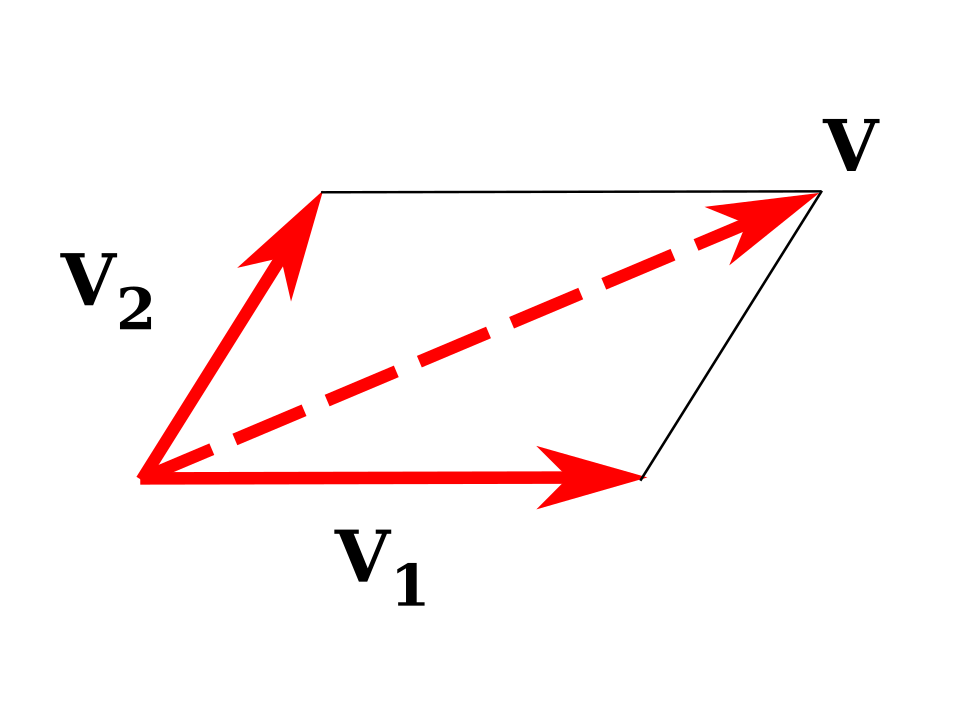
Vector Addition
Geometrically: Use the triangle rule (place the tail of b at the head of a) or parallelogram rule (both tails at the same point).
Algebraically: a + b = (a₁ + b₁, a₂ + b₂, a₃ + b₃).
Vector Subtraction
a − b = (a₁ − b₁, a₂ − b₂, a₃ − b₃).
Scalar Multiplication
k · a = (ka₁, ka₂, ka₃). If k > 0: same direction; if k < 0: opposite direction; if |k| > 1: longer; if |k| < 1: shorter.
Dot Product
a · b = |a||b| cos(a, b)
If vectors are given by coordinates: a · b = a₁b₁ + a₂b₂ + a₃b₃.
The dot product equals zero if and only if the vectors are orthogonal (perpendicular).
Sample Problem
Prove that the triangle with vertices A(6,−4,2), B(3,2,3), C(3,−5,−1) is right-angled.
Solution: AB = (−3, 6, 1), CA = (3, 1, 3). Dot product: (−3)(3) + 6(1) + 1(3) = −9 + 6 + 3 = 0. Since the dot product is zero, vectors AB and CA are perpendicular. Triangle ABC is right-angled at A.