Dot Product
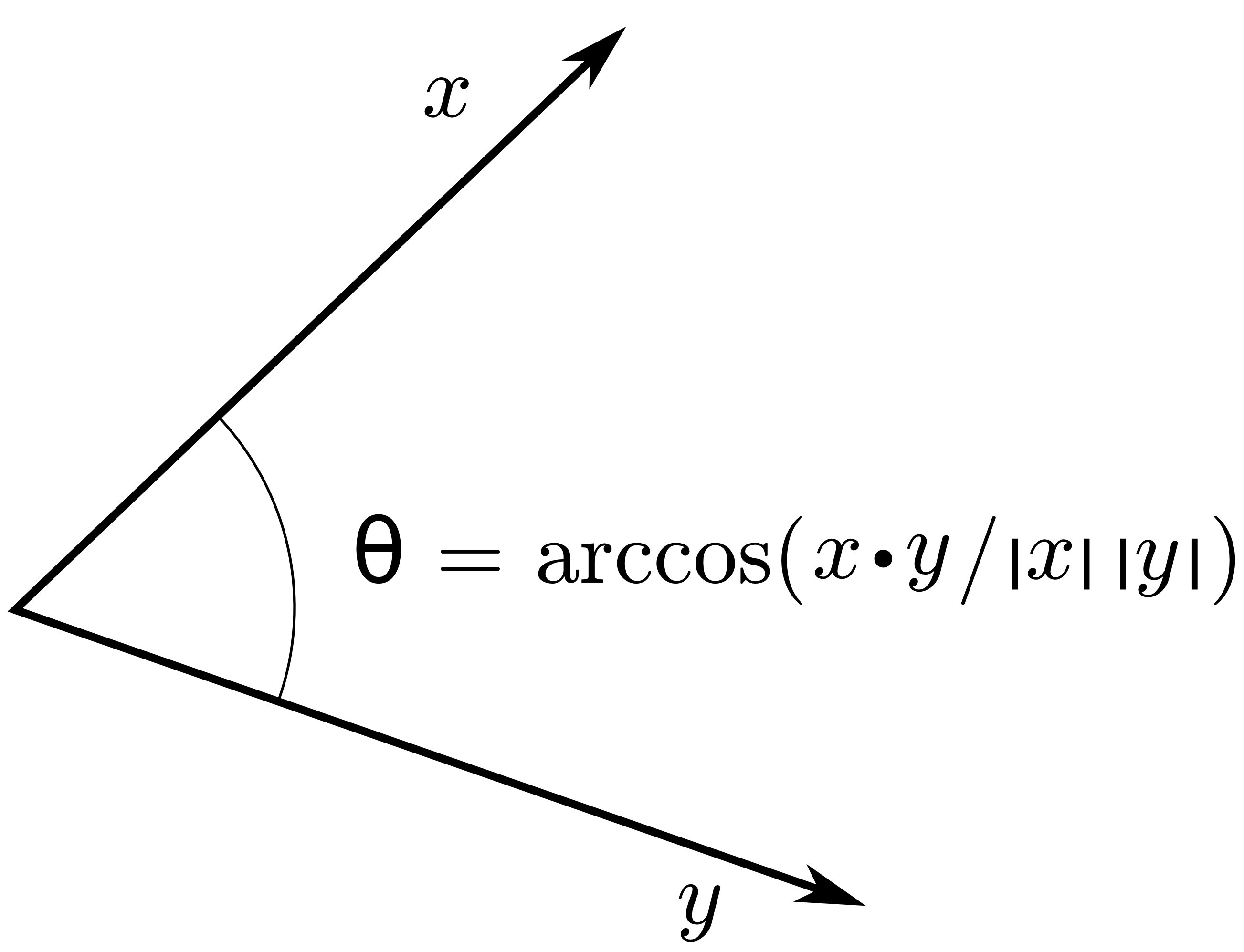
Definition of the Dot Product
The dot product (also called the scalar product or inner product) of two vectors a and b is defined as: a · b = |a| · |b| · cos θ, where θ is the angle between the vectors (0° ≤ θ ≤ 180°). The result of the dot product is always a scalar (a real number), not a vector.
In coordinate form, for 2D vectors a = (a₁, a₂) and b = (b₁, b₂): a · b = a₁b₁ + a₂b₂. For 3D vectors: a · b = a₁b₁ + a₂b₂ + a₃b₃.
Properties of the Dot Product
Commutativity: a · b = b · a.
Distributivity: a · (b + c) = a · b + a · c.
Scalar multiplication: (ka) · b = k(a · b) for any scalar k.
Self-product: a · a = |a|², which is useful for finding the length of a vector from its coordinates: |a| = √(a · a).
Finding the Angle Between Vectors
From the definition: cos θ = (a · b) / (|a| · |b|). This is one of the most important applications of the dot product.
Example: Find the angle between a = (3, 4) and b = (5, 12).
a · b = 3·5 + 4·12 = 15 + 48 = 63; |a| = 5; |b| = 13. So cos θ = 63 / (5 · 13) = 63/65, giving θ ≈ 14.25°.
Perpendicularity Condition
Two non-zero vectors are perpendicular (orthogonal) if and only if their dot product equals zero: a ⊥ b ⟺ a · b = 0.
This follows directly from the formula: if cos θ = 0, then θ = 90°.
Example: Are the vectors a = (2, 3) and b = (6, −4) perpendicular? a · b = 2·6 + 3·(−4) = 12 − 12 = 0. Yes, they are perpendicular.
Projection of a Vector
The scalar projection of a onto b is: projsc a onto b = (a · b) / |b|.
The vector projection of a onto b is: projb a = ((a · b) / |b|²) · b.
Example: Project a = (4, 3) onto b = (1, 0) (the x-axis). a · b = 4, |b|² = 1, so projb a = 4 · (1, 0) = (4, 0).
Sign of the Dot Product
If a · b > 0, the angle between the vectors is acute (0° < θ < 90°).
If a · b = 0, the vectors are perpendicular (θ = 90°).
If a · b < 0, the angle between the vectors is obtuse (90° < θ < 180°).
Work and the Dot Product
In physics, the work done by a force F over a displacement d is: W = F · d = |F||d| cos θ. Only the component of force in the direction of displacement contributes to work. If the force is perpendicular to the displacement, no work is done.