Similarity of Triangles
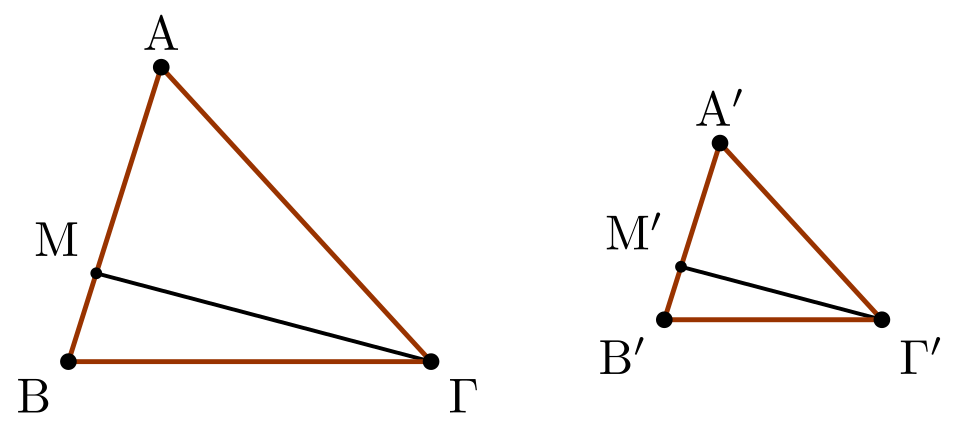
Definition of Similar Triangles
Two triangles are similar (ΔABC ~ ΔA₁B₁C₁) if their corresponding angles are equal and their corresponding sides are proportional. The ratio of corresponding sides is the similarity coefficient k. If k = 1, the triangles are congruent.
Areas of similar triangles are in the ratio k², while perimeters are in the ratio k.
Similarity Criteria
1. AA (Two Angles) — If two angles of one triangle equal two angles of another, the triangles are similar. The third is automatically equal since α + β + γ = 180°.
2. SAS (Two Sides and Included Angle) — If two sides are proportional and the included angle is equal, the triangles are similar.
3. SSS (Three Sides) — If all three sides are proportional, the triangles are similar.
Geometric Means in Right Triangles
When the altitude h is drawn to the hypotenuse c, it divides c into segments p and q. Three relations hold:
- h² = p·q (altitude theorem)
- a² = p·c (leg rule for leg a)
- b² = q·c (leg rule for leg b)
These provide a direct proof of the Pythagorean theorem: a² + b² = pc + qc = (p+q)c = c².
Property of Medians
The medians of a triangle intersect at one point (the centroid) and divide each other in the ratio 2:1, counting from the vertex. The three medians divide the triangle into six equal-area smaller triangles.