Classification of Triangles
What Is a Triangle?
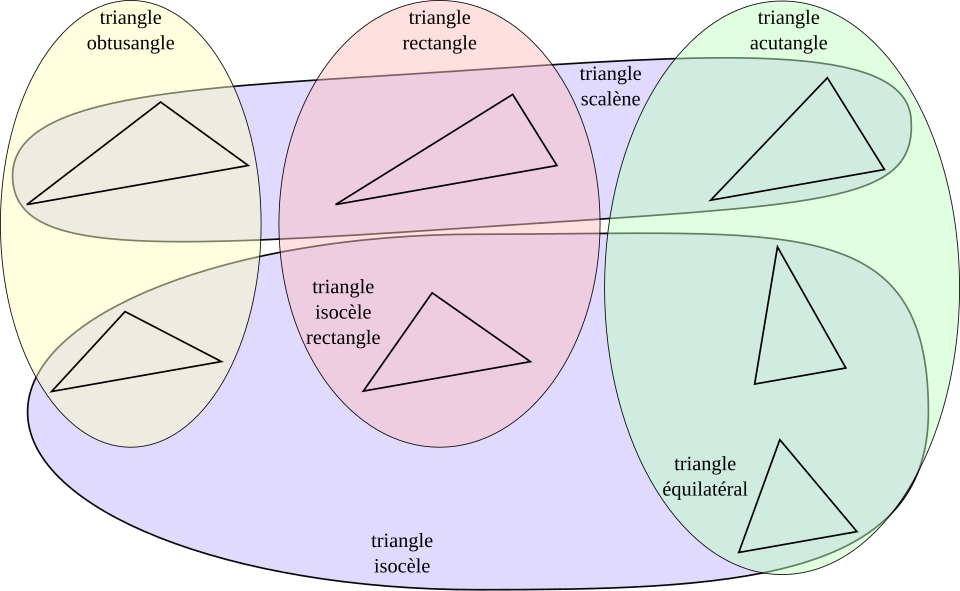
A triangle is a polygon that has three vertices (angles) and three sides. Another definition: a triangle is a part of a plane bounded by three points and three line segments connecting these points pairwise.
Classification by Angles
1. Acute Triangle — all angles are acute, meaning each angle is less than 90°.
2. Right Triangle — contains one right angle equal to 90°. In a right triangle, the two sides forming the right angle are called legs (or catheti), and the side opposite the right angle is called the hypotenuse. The hypotenuse is always the longest side.
3. Obtuse Triangle — contains one obtuse angle, meaning an angle greater than 90°.
A triangle cannot have more than one right angle or more than one obtuse angle. Otherwise, the sum of its angles would exceed 180°.
Classification by Side Lengths
1. Scalene Triangle — all sides have different lengths. As a result, all its angles are also different.
2. Isosceles Triangle — two sides are equal in length. The equal sides are called the legs; the third side is called the base. An important property: the angles opposite the equal sides are equal.
3. Equilateral Triangle — all three sides are equal. All angles are equal, each measuring 60°. An equilateral triangle is a special case of an isosceles triangle.
Important Relationships
In an equilateral triangle with side a: altitude h = a√3/2, area S = a²√3/4, and circumradius R = a/√3.