Pythagorean Theorem
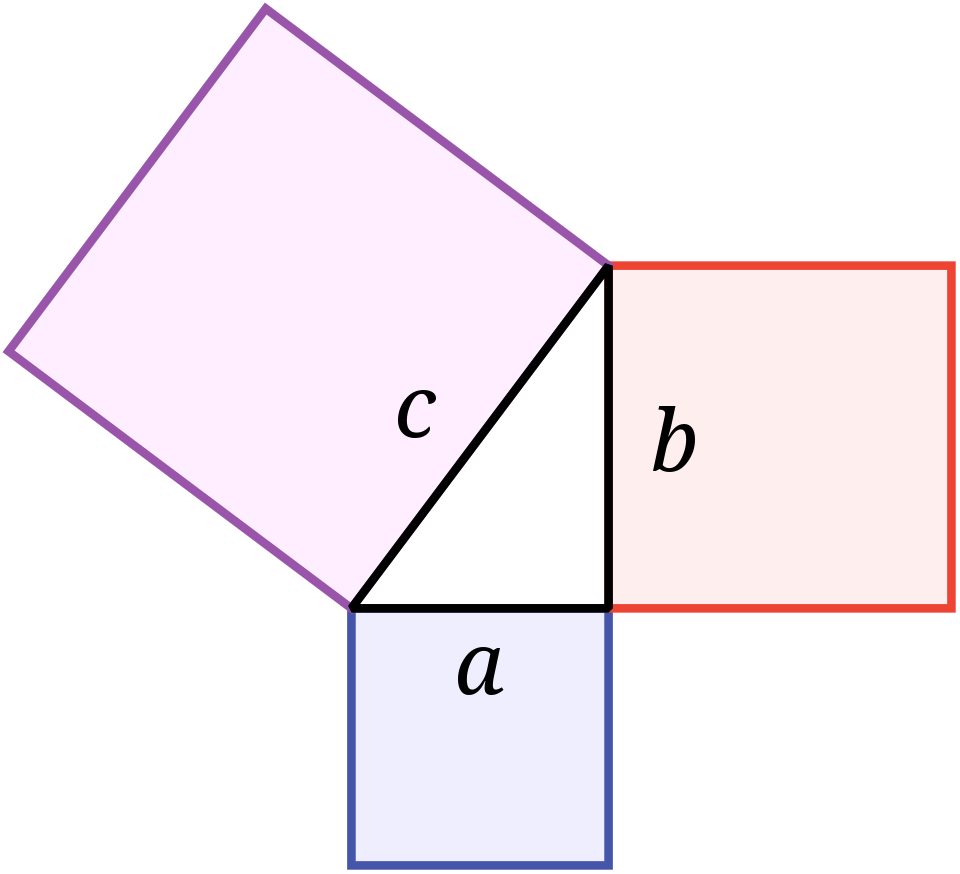
The Pythagorean Theorem
For a right triangle with legs a and b and hypotenuse c: c² = a² + b². This means the area of the square on the hypotenuse equals the sum of the areas of the squares on the two legs.
Proof Using Similar Triangles
Consider a right triangle ABC with right angle C. Draw the altitude CD from vertex C to the hypotenuse AB. The triangles ACD and BCD are similar to the original triangle ABC. From similarity we obtain: AC/AB = CD/AC and BC/AB = CD/BC. After multiplying and transforming: AC² + BC² = AB².
Proof Using Areas
Construct a square whose side length equals the hypotenuse c. Inside the square place four identical right triangles. The area of the large square is c² = 4(½ab) + (a − b)². Simplifying gives c² = a² + b².
Proof Using Coordinates
Place the triangle with vertices at (0,0), (a,0), and (0,b). The hypotenuse connects (a,0) and (0,b). Using the distance formula: c = √(a² + b²), so c² = a² + b².
Garfield's Method
Construct a trapezoid from two right triangles. The area of the trapezoid can be calculated in two ways: as the sum of areas of triangles, and using the trapezoid area formula. Equating the two expressions leads to c² = a² + b².
Pythagorean Triples
Common triples: (3,4,5), (5,12,13), (8,15,17), (7,24,25). Any multiple is also valid: k·(3,4,5) = (3k, 4k, 5k). The formula for generating all primitive triples: a = m² − n², b = 2mn, c = m² + n².
The Converse
If in a triangle c² = a² + b², then the triangle is right-angled.