Advertisement
Quadratic Equations
Quadratic Equations
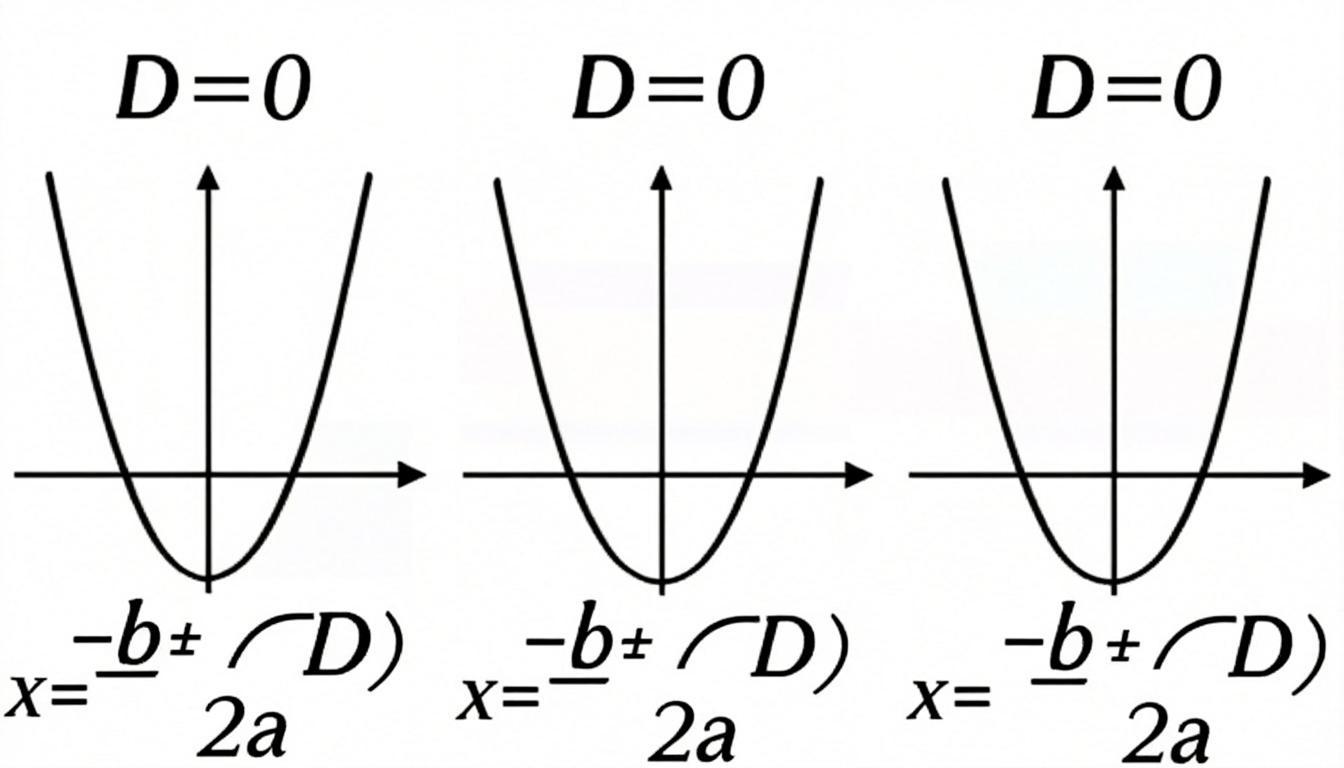
A quadratic equation has the form ax² + bx + c = 0 (a ≠ 0). The discriminant D = b² − 4ac determines the number and type of roots:
- If D > 0: two distinct real roots x = (−b ± √D) / 2a
- If D = 0: one double root x = −b/2a
- If D < 0: no real roots
Vieta's Theorem
If x₁ and x₂ are roots: x₁ + x₂ = −b/a and x₁ · x₂ = c/a. For x² − 5x + 6 = 0: two numbers summing to 5 and multiplying to 6 → x₁ = 2, x₂ = 3.
Incomplete Quadratics
If b = 0: ax² + c = 0 → x = ±√(−c/a) (real only if c/a < 0).
If c = 0: ax² + bx = 0 → x(ax + b) = 0 → x = 0 or x = −b/a.
The Transfer Method
Replace ax² + bx + c = 0 with y² + by + ac = 0. The coefficient a is "transferred" to the constant term. If y₁ and y₂ are roots of the new equation, then x₁ = y₁/a, x₂ = y₂/a.
Example: 6x² − 7x − 3 = 0 → Transfer: y² − 7y − 18 = 0 → roots 9 and −2 → x = 9/6 = 3/2 and x = −2/6 = −1/3.
Advertisement
More in 🔢 Polynomials
Advertisement