Monomials and Polynomials
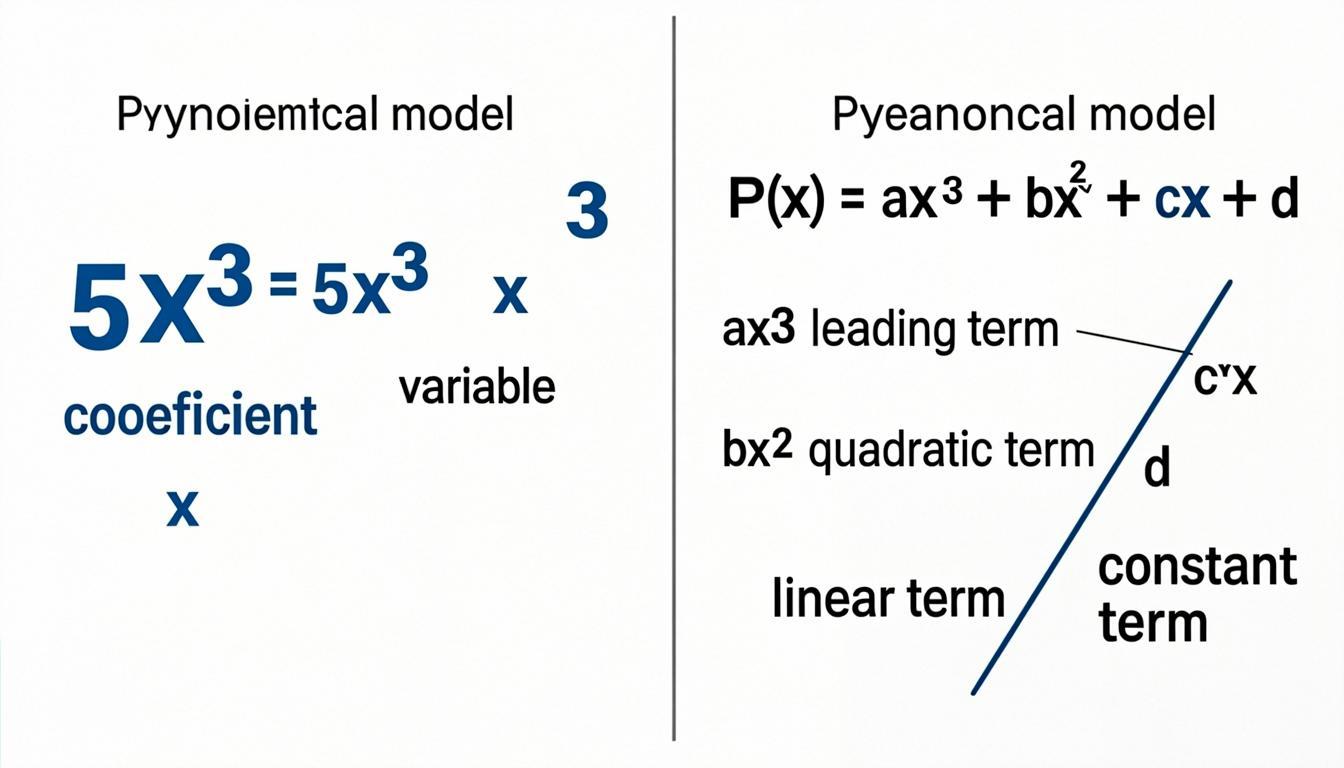
Monomials
A monomial is an algebraic expression that contains numbers, variables raised to natural-number powers, and multiplication operations only. A monomial does not contain addition or subtraction between separate terms.
Examples: 3a, (2.5a³), (5ab²). The expression a + b is not a monomial because it contains addition.
Properties of Monomials
Degree: The sum of the exponents of all variables. Example: 5a³ has degree 3; 2x²y⁴ has degree 6.
Coefficient: The numerical factor. Example: coefficient of 5a is 5; coefficient of −3x²y is −3.
Standard form: Numerical coefficient first, followed by variable powers. Example: 3a(2.5a³) = 7.5a⁴.
Operations with Monomials
Addition/Subtraction: Only like terms (same variable parts): 3x² + 5x² = 8x².
Multiplication: Multiply coefficients, add exponents: (2a²b)(3ab³) = 6a³b⁴.
Division: Divide coefficients, subtract exponents: 12x⁵y³ / 3x²y = 4x³y².
Raising to a power: Raise the coefficient, multiply exponents: (2a³b²)² = 4a⁶b⁴.
Polynomials
A polynomial is a sum of monomials. General form: P(x) = aₙxⁿ + aₙ₋₁xⁿ⁻¹ + … + a₁x + a₀. The degree is the highest exponent with a non-zero coefficient. A polynomial of degree 1 is linear, degree 2 is quadratic, degree 3 is cubic.
A polynomial of degree n has at most n roots. Bézout's Theorem: If P(a) = 0, then the polynomial is divisible by (x − a).