Compound Percentages
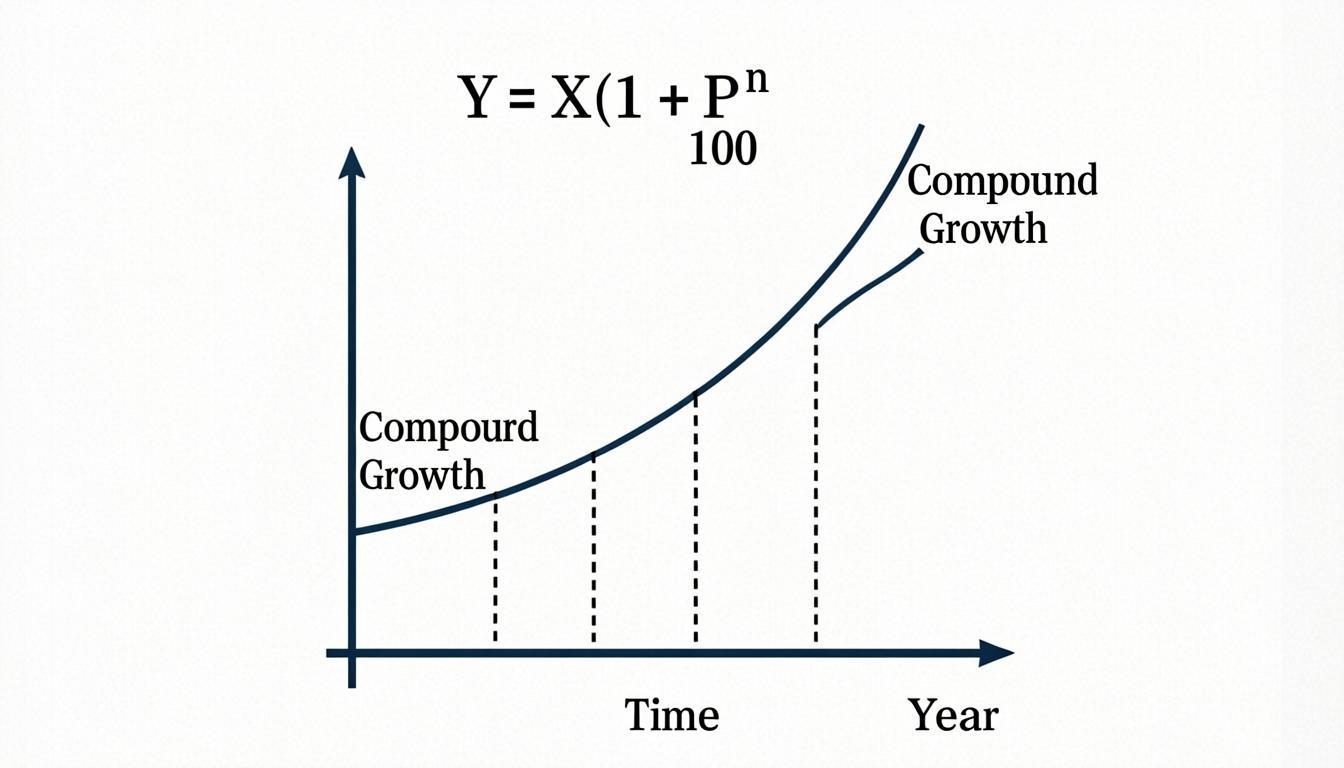
Compound Percentage Formula
When a quantity changes by P% repeatedly over n periods, the final value is: Yₙ = X · (1 + P/100)ⁿ, where X is the initial value.
Example: A $1000 deposit at 5% annual compound interest for 3 years: Y₃ = 1000 · (1.05)³ = $1,157.63.
Simple vs. Compound Interest
Simple interest: Yₙ = X(1 + P·n/100) — interest calculated only on the principal.
Compound interest: Yₙ = X(1 + P/100)ⁿ — interest calculated on the accumulated amount. Compound interest always yields more for n > 1.
Successive Different Percentages
If a quantity changes by different percentages each period: Y = X · (1 + P₁/100) · (1 + P₂/100) · … · (1 + Pₙ/100).
Example: A stock rises 10% then falls 10%: Y = X · 1.10 · 0.90 = 0.99X — a net loss of 1%.
Proof by Mathematical Induction
The formula Yₙ = X(1 + P/100)ⁿ is true for every natural number n, which can be verified by mathematical induction.