Inverse Proportionality
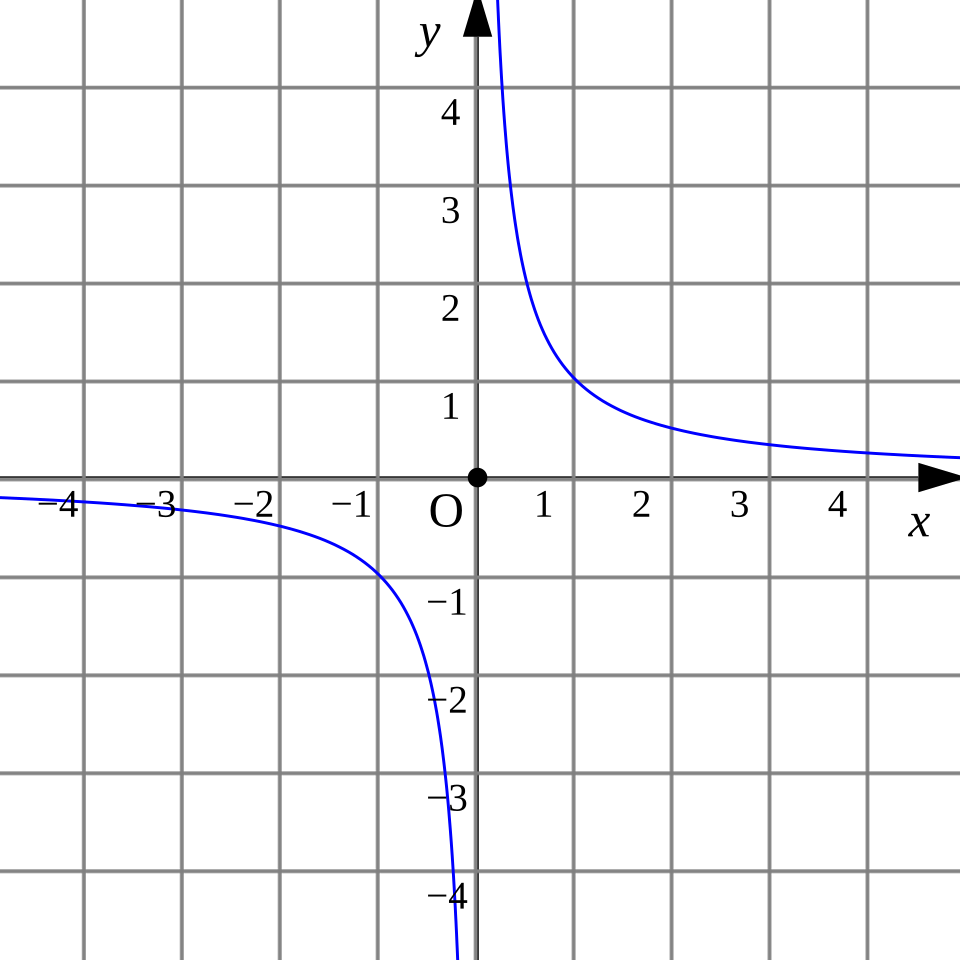
Inverse Proportionality
Imagine an object moving at a constant speed from point A to point B. The time required to travel this distance depends on the speed of movement. Suppose the distance between A and B is 150 m, where v is the speed (m/s) and t is the travel time (s). Then: t = 150 / v.
Substitute several values: if v = 5, then t = 30; if v = 10, then t = 15; if v = 15, then t = 10.
An inverse proportionality is a function defined by: y = k/x, where k is a nonzero number. The variable y is said to be inversely proportional to the variable x.
Key Property
From the formula y = k/x, it follows that: xy = k. The converse is also true: if xy = k (k ≠ 0), then y = k/x.
To determine whether a function is an inverse proportionality, compare the products xy for all corresponding values. If these products equal the same nonzero number k, the function is an inverse proportionality.
Property of Ratios
If the function x → y is an inverse proportionality and (x₁, y₁), (x₂, y₂) are pairs of corresponding values, then: x₁/x₂ = y₂/y₁.
Proof: From y = k/x: y₁ = k/x₁, y₂ = k/x₂. Therefore: y₂/y₁ = (k/x₂)/(k/x₁) = x₁/x₂.
Problem
A car traveling at 60 km/h covered the distance from city A to city B in 4 hours. How much time for the return trip at 80 km/h?
Solution: Since time is inversely proportional to speed: x/4 = 60/80, so 80x = 240, giving x = 3 hours.